When family life becomes difficult, every conversation can feel like a new problem. People stop hearing each other, and small disagreements grow into large ones. The range of services here is built to bring shape to those moments — to make difficult conversations easier to hold, and to help workable decisions take form without the unnecessary fight.

Family separation rarely affects a single area of life. When relationships shift, questions tend to rise on every front at once — children, finances, the home, parenting plans, communication, and a thousand small details of daily life. The matters become tangled, and it becomes hard to know where to begin.
National Mediation is built to help with all of that. The aim is not to add to the pressure. The aim is to make the toughest conversations easier to hold so that decisions can be made without the unnecessary argument. Whether the matter is separation, time arrangements for children, Family Mediation Voucher Scheme UK, the financial picture or any combination of the issues that surface during a family change, mediation provides a framework in which the work of finding a way forward can begin — even if a complete resolution is not possible all at once.
This is a service for those who feel lost, exhausted or unsure how to begin. It is also for people who would prefer to handle things well, and who do not believe everything has to feel like a fight. It exists for families who want support that feels grounded, fair and easy to engage with not another formal system that adds layers of stress.
Experience and neutrality come together with an approach that puts the people involved first. The setting is private, focused, Contact Us, and human. It allows families to make decisions that work for them, without the conflict that so often gets in the way.

Every family is different. Some need help with parenting. Some need help with finances. Some need both. Mediation here is shaped to the people in the room — adaptable in format, but consistent in care.
A guided conversation about the matters that come up when family life shifts.
A more measured way to handle the practical shifts that follow the end of a marriage.
The first private session — a chance to consider the situation and the available options.
Mediation that fits around work, travel, childcare and life as it is.
A format for situations where a direct conversation would be too difficult.
Time-sharing, handovers, holidays and the rhythms of everyday childhood.
An age-appropriate way to take a child's voice into account when relevant.
Practical conversations about the financial care of children after separation.
Considered support for wider family ties during difficult family changes.
A measured space to work through sensitive concerns about a child's relationship with each parent.
Workable, realistic plans for shared parenting after separation.
An honest, practical conversation about financial pressure and how to handle it.
Income, savings, debts, the home and the long view, discussed together.
Support for those eligible, easing the cost barrier at a difficult time.
Considering the long-term financial picture with the care that pensions deserve.
The home as both a financial asset and a place of memory — handled steadily.

Family mediation is often the first step people take to settle disputes outside of court. It is a guided meeting between the people most affected by a family matter, Child Arrangements UK Explained. Unlike a judge, the mediator is impartial. They do not arbitrate between right and wrong. They are there to help people speak more clearly, listen more carefully, and work toward practical outcomes.
This kind of support can be especially useful when emotions are heightened. Family disputes are rarely only about the present moment. They tend to carry the weight of the past, anxiety about what lies ahead, and frustration about the things that did not turn out as hoped. That can make it difficult to focus on the decisions that still need to be made.
Family mediation refocuses the conversation on what matters. It establishes a secure and orderly environment in which people can work through difficulty one step at a time. That might involve children, finances, property or communication. It might be one matter or several. What stays consistent is that the people involved have a real chance to be heard and understood.

Divorce often feels like the end of one life and the beginning of another, both at the same time. Even when ending a marriage is the right step, parting can be painful and unsettling. There are practical questions to answer, but emotional questions sit alongside them. People often wonder what comes next, especially when the future feels unclear.
Divorce mediation provides a calmer way to work through the challenges of separation, Can Divorce Mediation Help. It supports couples in conversations about children, money, property and the day-to-day practicalities that follow the end of a marriage. The advantage of mediation here is that it keeps both people actively involved in the decisions that will shape their lives, rather than passing those decisions over to a more formal process.
It can also lighten the emotional weight on both sides. Divorce brings with it fear, regret, and a long list of questions. Mediation cannot remove those feelings, but it does make handling them more bearable. It allows hard subjects to be discussed without every conversation becoming another source of stress.

The MIAM — short for Mediation Information and Assessment Meeting — is often one of the first steps in family mediation. It is a private initial session in which the situation can be discussed and the next steps considered. It is space to talk, to ask questions, and to work out what kind of support is most appropriate.
Many people find the MIAM reassuring because it removes some of the unknown. Family conflict can feel bewildering, particularly when the available options are not clear. A MIAM helps to translate that uncertainty into clarity. The mediator listens, looks at the situation, and considers whether mediation is likely to be helpful. Sometimes mediation is the right step. Sometimes another approach would be more useful. The aim is to be honest and considered.
No one is being pushed into mediation during a MIAM. It is about helping people make informed decisions. That first conversation can lift much of the weight, simply by giving people a clearer sense of what their next steps could be.
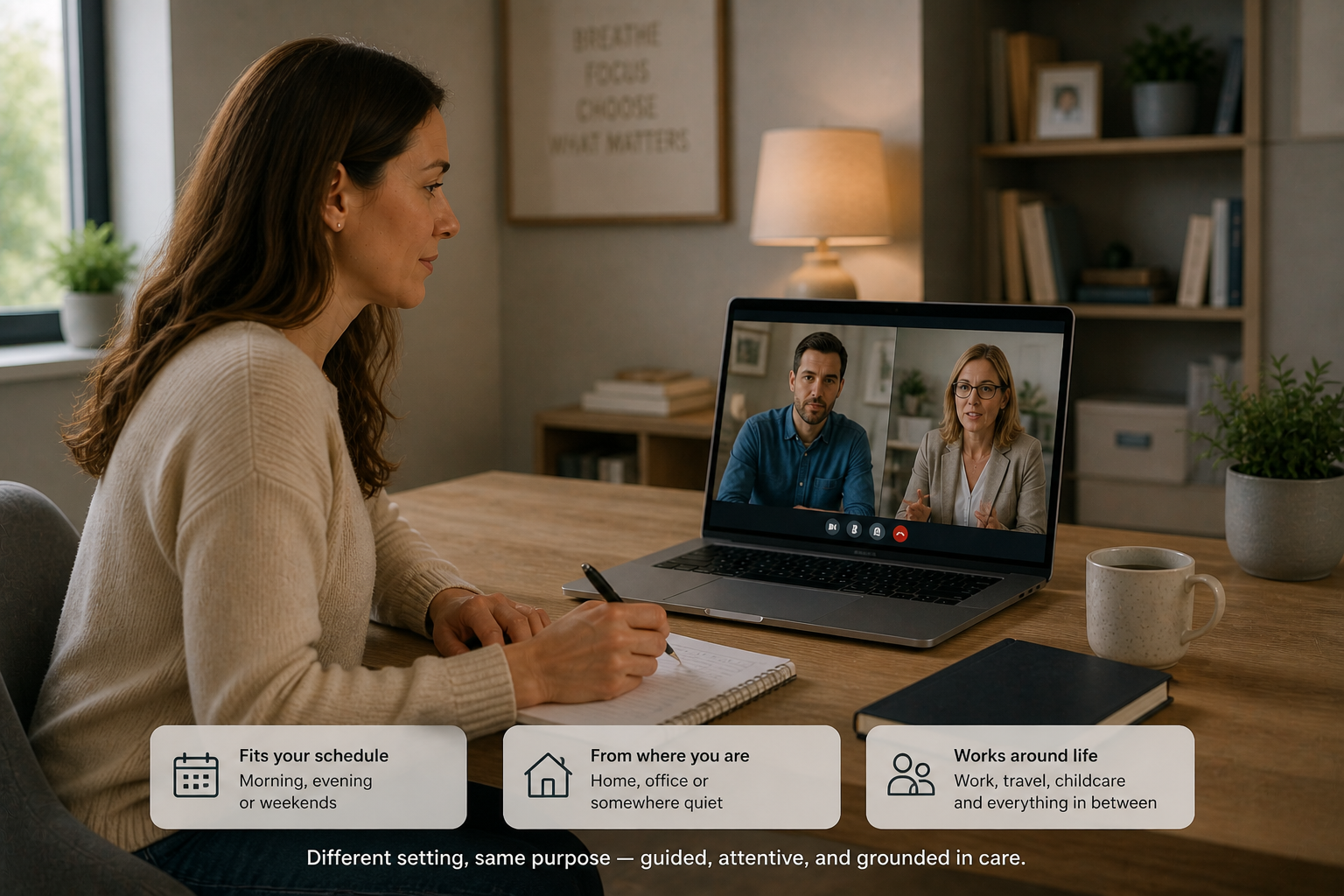
Family matters do not pause for a quiet schedule. People juggle work, children, travel, stress, Simple Guide Every Couple Consent Order in the UK and daily responsibilities while trying to navigate change. Online mediation makes it possible to engage with the process without everyone needing to be in the same physical place. It is particularly useful when distance is a factor, when one person finds travelling difficult, or when an in-person meeting feels like too large a step.
The structure remains the same. There is still space to talk. There is still careful guidance, attentive listening, and considered exploration of the issues. What changes is the format and that change is enough to make the process feel reachable for many families.
Some find online mediation more comfortable because the screen creates a small but useful sense of distance. Others appreciate the convenience. Either way, the goal stays consistent: keeping families in a constructive process and out of the courtroom whenever possible.
Not every situation allows for a direct conversation. Sometimes people are not ready to be in the same room. Sometimes communication has broken down so completely that meeting face-to-face would only escalate things. Sometimes one or both people feel too unsettled, or too reactive, for direct contact to be helpful.
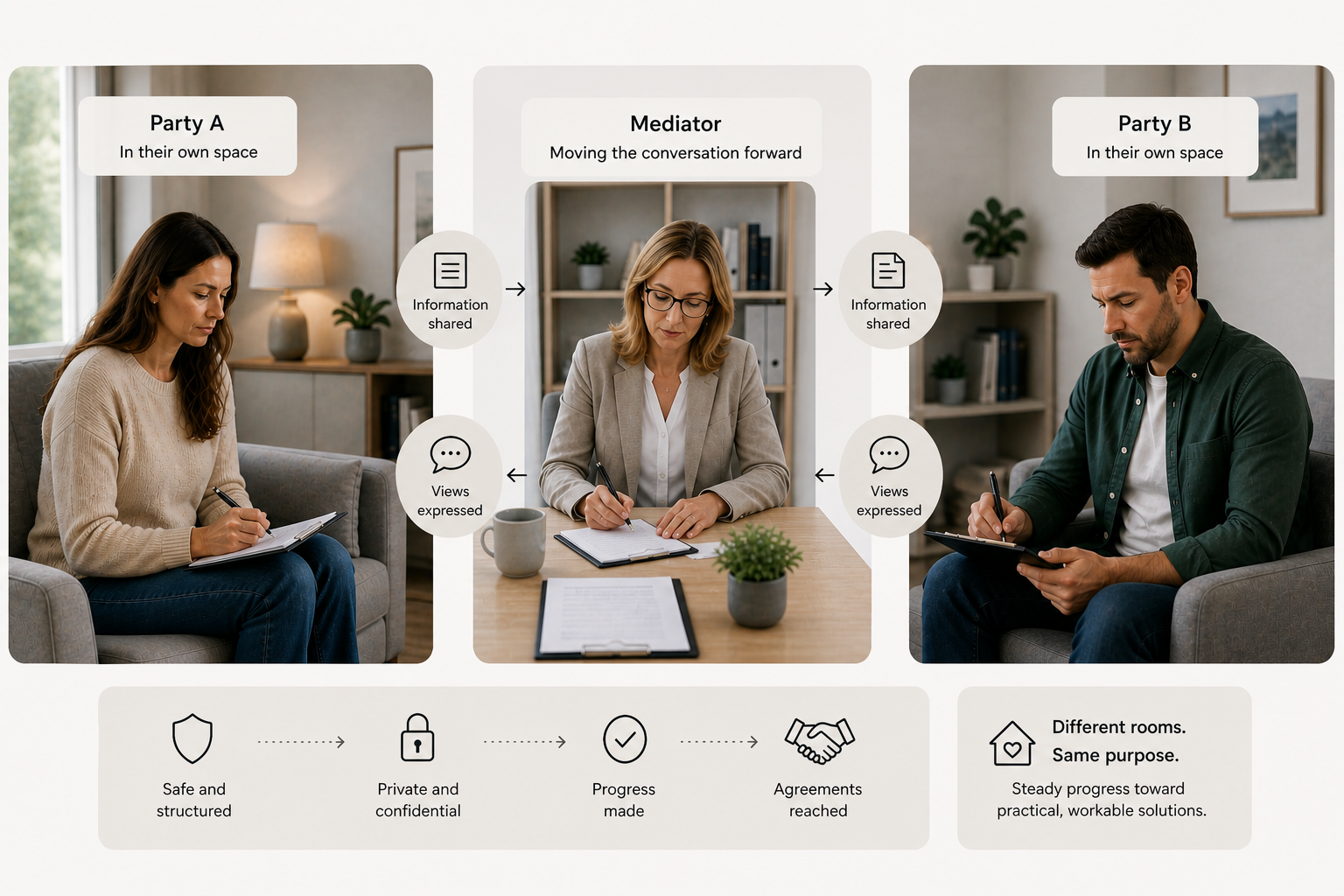
Shuttle mediation offers an alternative. The mediator speaks with one person at a time and moves between the two parties. The conversation continues, but it does so in a format that can ease pressure and create a calmer immediate atmosphere. There is no need for both people to share a space.
This format can be especially appropriate in higher-conflict or emotionally vulnerable situations where additional space and structure are needed. Both people still have the opportunity to be heard. Decisions can still be examined and refined. It just happens in a way that preserves a sense of safety. For many families, it is the format that makes progress possible at all.
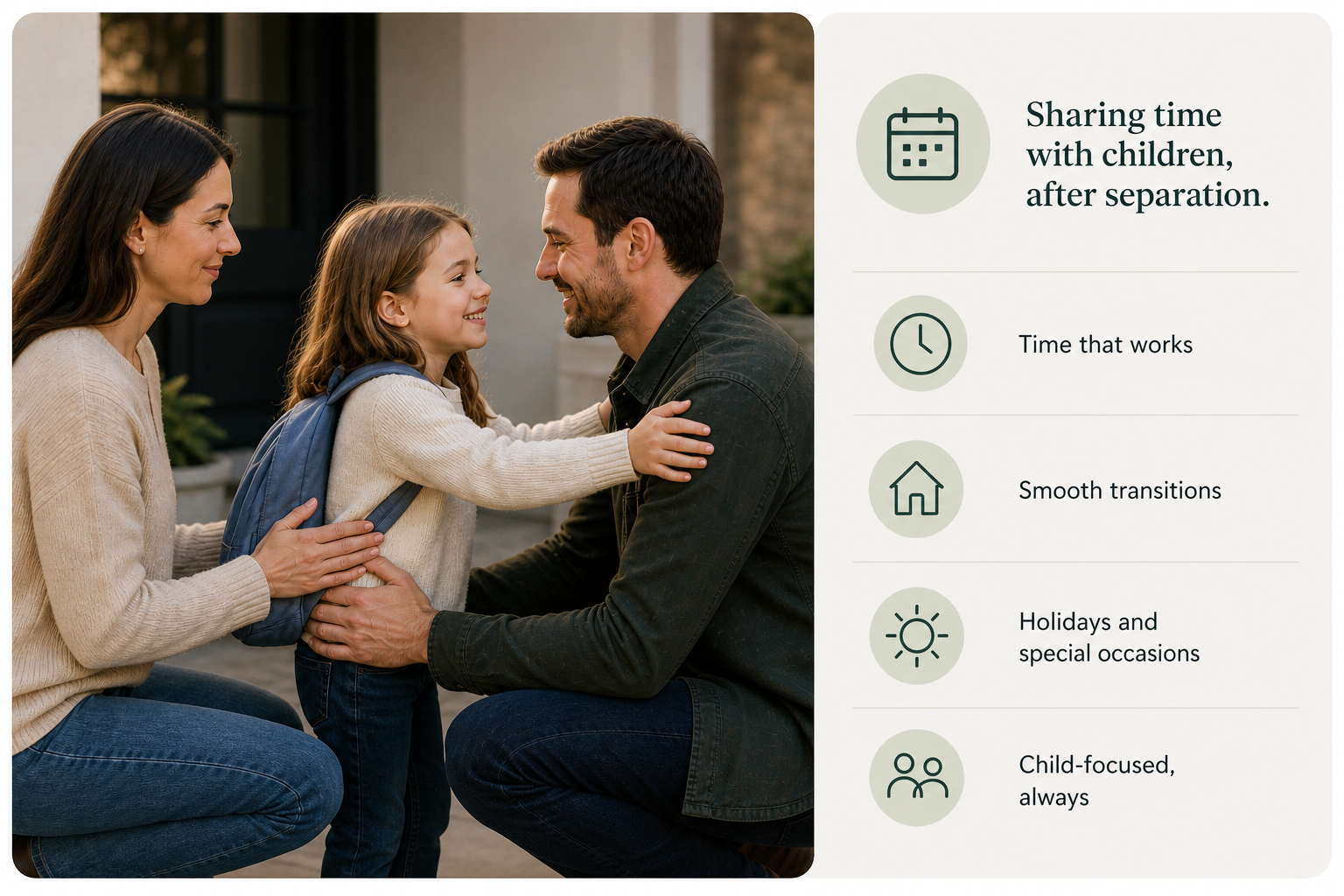
One of the most pressing issues for separating parents is how children will share time with each parent. Child access mediation provides a balanced, child-centred space to work through those arrangements. The aim is for both parents to develop genuine plans about the way time is shared, how transitions are handled, and how a child's routine remains as steady as possible.
These conversations are emotional, because they directly shape the relationship between parent and child. Fairness, history, trust and responsibility can all surface together. That is why a step-by-step process is so helpful — it keeps the focus on the child, rather than on older arguments.
Child access mediation considers everyday schedules, school holidays, special occasions, transport, handovers, and communication between homes. The goal is not to have parents agree on every single detail, but to create a workable plan a child can live within — one that gives daily life a sense of dependability.
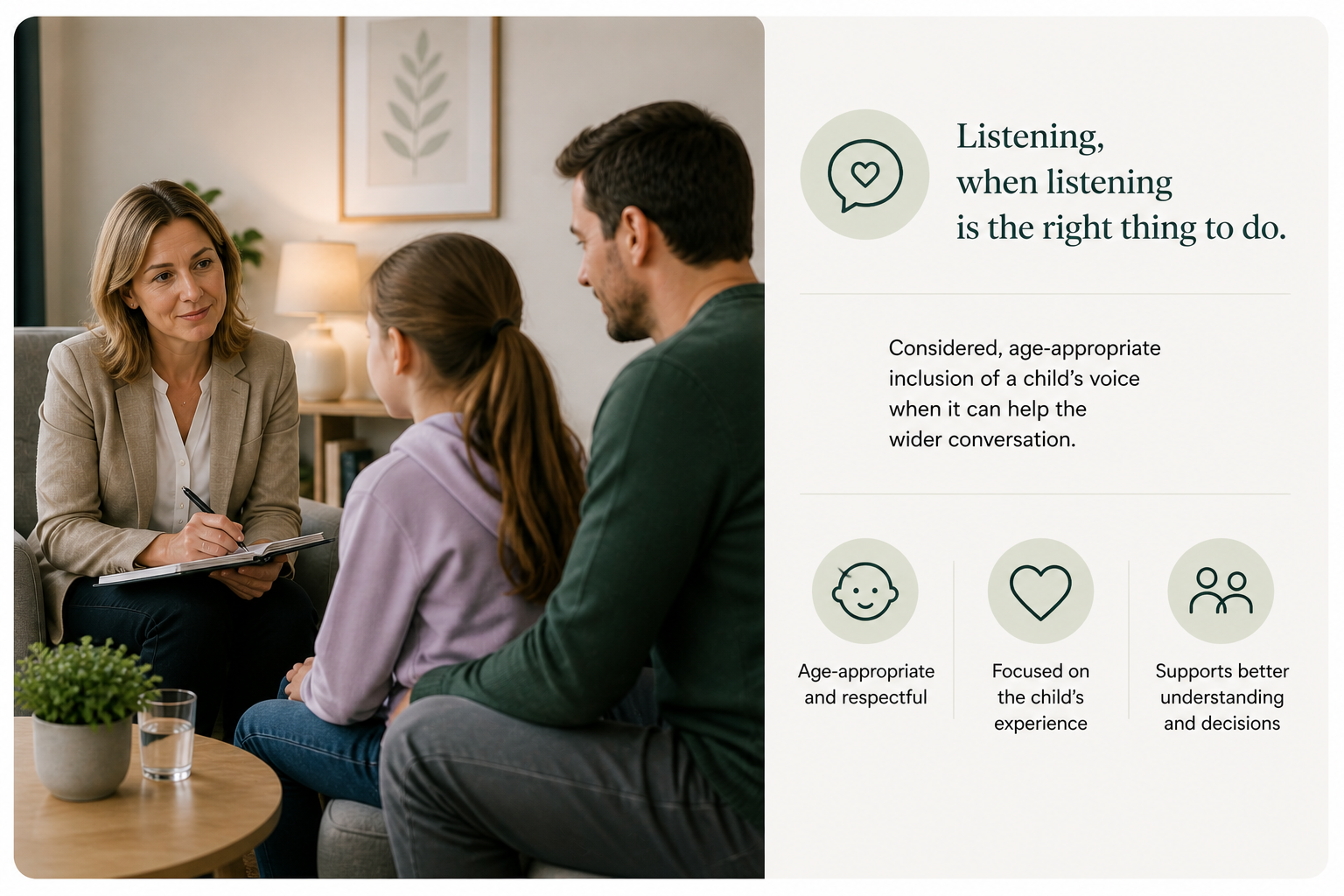
Adult conflict can affect children even when nobody intends it to. Child-inclusive mediation recognises that children may have views, feelings or concerns that can usefully inform the wider conversation. It is done carefully and sensitively, with the child's wellbeing at the centre.
This does not mean that children are asked to take on adult responsibility or to choose between parents. It simply means that, when appropriate, their experience is acknowledged in an age-suitable and considered way. For many parents, this brings a clearer view of how the situation is affecting their child. It refocuses the conversation on what the child needs emotionally, practically, and in everyday life.
Care is essential here. Child-inclusive mediation is not about pressuring children. It is about ensuring that, while adults are working through difficult choices, the child's experience is not forgotten. Used well, it can help the family move forward with greater understanding and compassion.

Financial matters become particularly delicate when children are involved. Child maintenance is part of the wider picture that supports a child's daily needs. Conversations about it touch on more than figures on a page — they affect the stability of each home and how fair the arrangement feels to everyone involved.
Mediation provides a safe and realistic space for these discussions. It allows people to consider what is genuinely needed, what is achievable, and how the arrangement is likely to hold over time. The aim is to ease confusion and to help families arrive at a clearer picture together. Strained communication often makes financial pressure feel even heavier. Mediation lifts the tone of those discussions toward something more respectful, allowing the practical realities of parenting to be considered without the conversation slipping into blame.
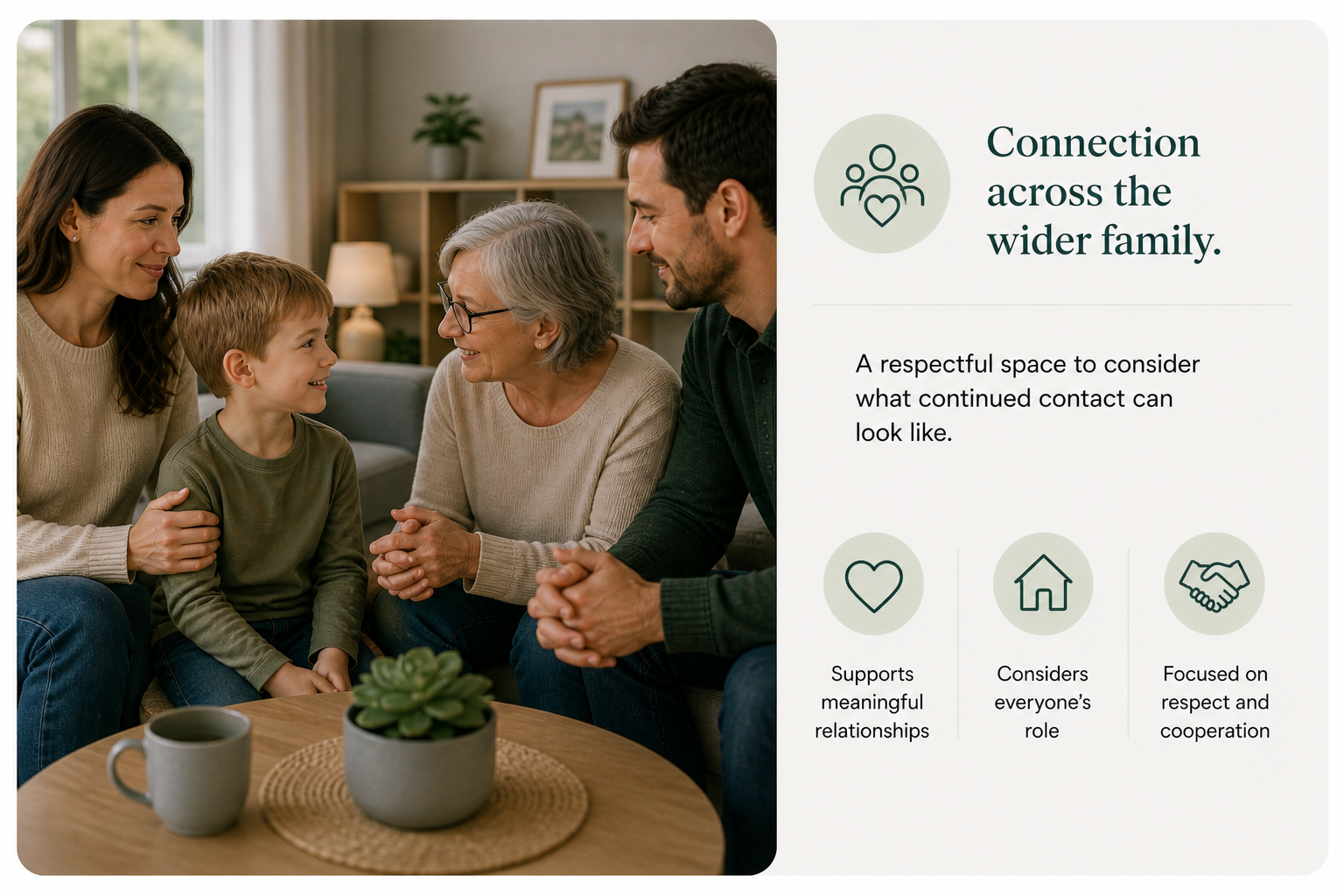
Grandparents often play a meaningful role in a child's life. When family relationships shift, those wider ties can become strained. A grandparent may suddenly find it harder to see a grandchild they love deeply. At the same time, parents may already be navigating the stress of a separation, with wider relationships unsettled.
Mediation in this context offers a dignified, respectful space to discuss those challenges. It allows families to consider what level of contact may be possible, what is genuinely best for the child, and how the conversation can be held with less adversarial energy. Emotion runs high in these situations love, history, disappointment and hope often arrive together. A measured conversation gives those feelings a place to be acknowledged, without losing sight of what matters most.
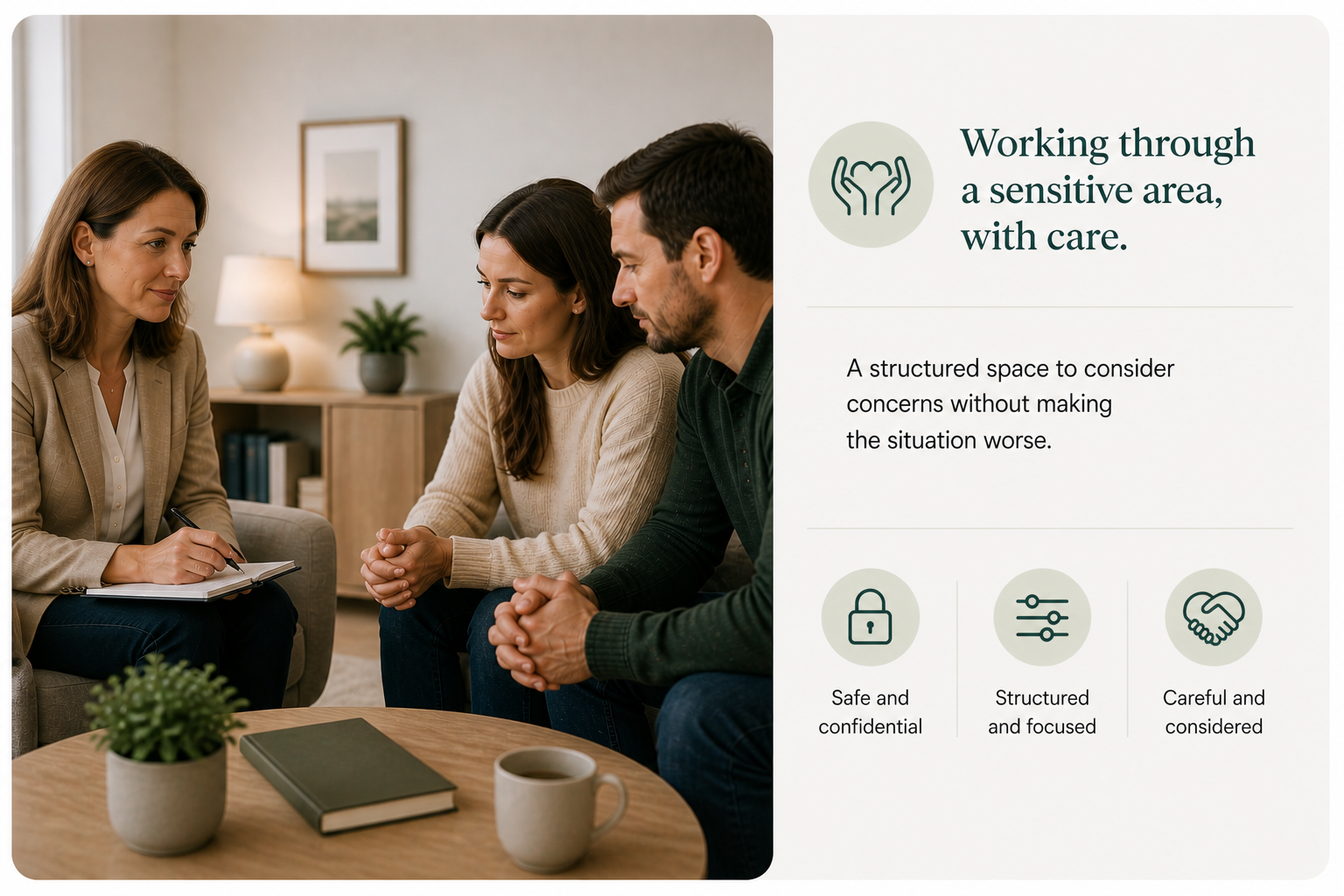
Concerns about parental alienation can be especially distressing for families. When a parent feels excluded from their child's life, or worries that their child is being influenced against them, the situation can quickly become highly emotional. It can bring anxiety, hurt and confusion to everyone involved.
Where appropriate, mediation can offer families a way to begin working through such concerns more safely and with more structure. It is not about minimising the seriousness of the issue. It is about preventing the conversation from making the situation worse. Mediation can support discussions about behaviours, communication patterns, and unresolved tension that may be affecting a child's relationship with one parent. The focus stays on reducing conflict and protecting the child from being placed in the middle.
These cases require sensitivity and time. They are rarely simple. But a measured space to talk can be a meaningful first step toward improvement.
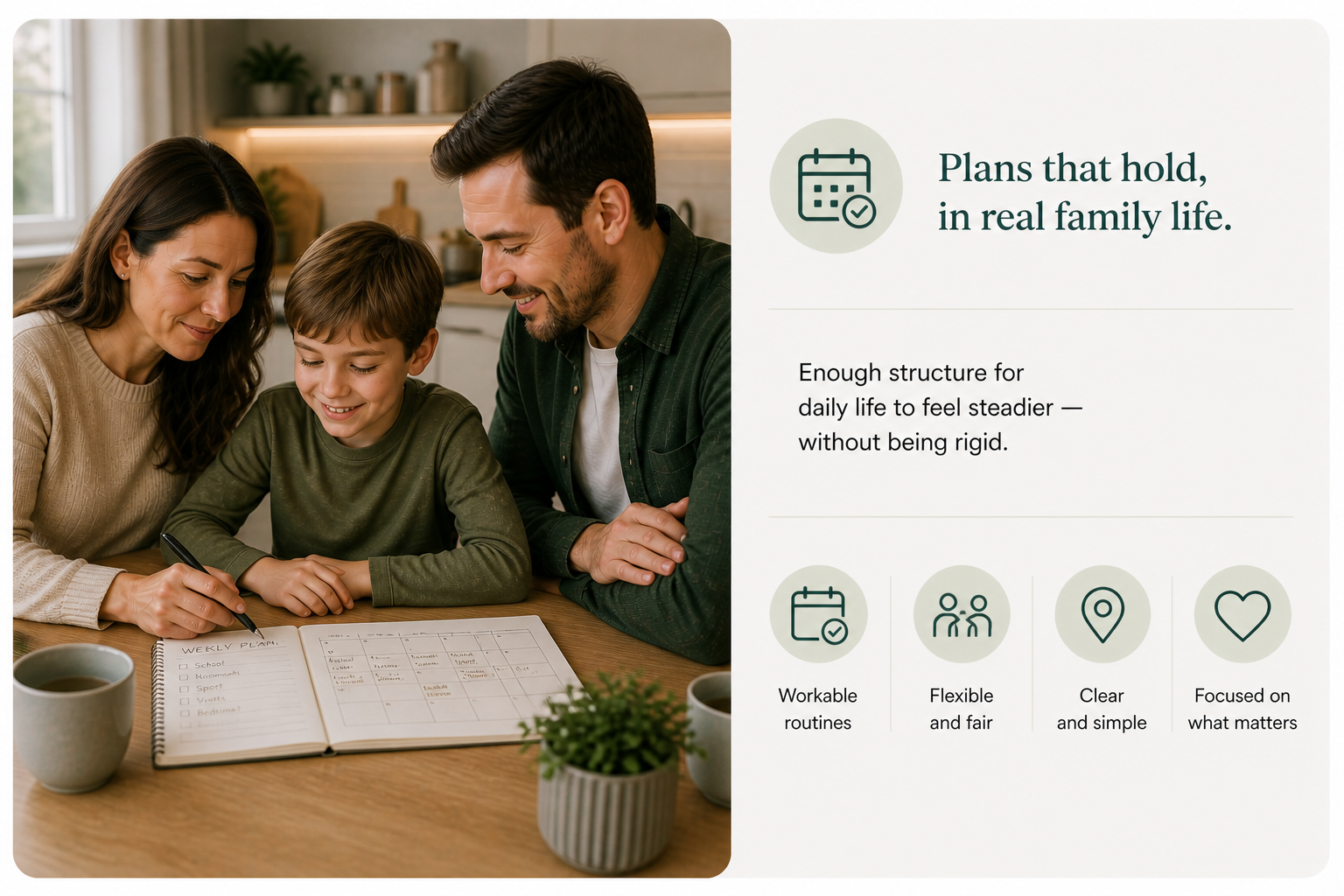
Clear plans for parenting after separation tend to work better. A parenting plan sets out how children will be cared for, how decisions will be made, and the practical arrangements that shape life across two homes. It can include routines, school plans, holidays, communication, handovers and many other everyday details.
Mediation supports parents in shaping a parenting plan that fits their particular family. That matters because no two families are alike. A plan needs to reflect the age and needs of the child, alongside the realities of each parent's daily life. Putting a plan together also reduces the risk of later misunderstandings — when expectations are clear, parents can feel more certain about what has been agreed, and children benefit from a calmer and more consistent rhythm.
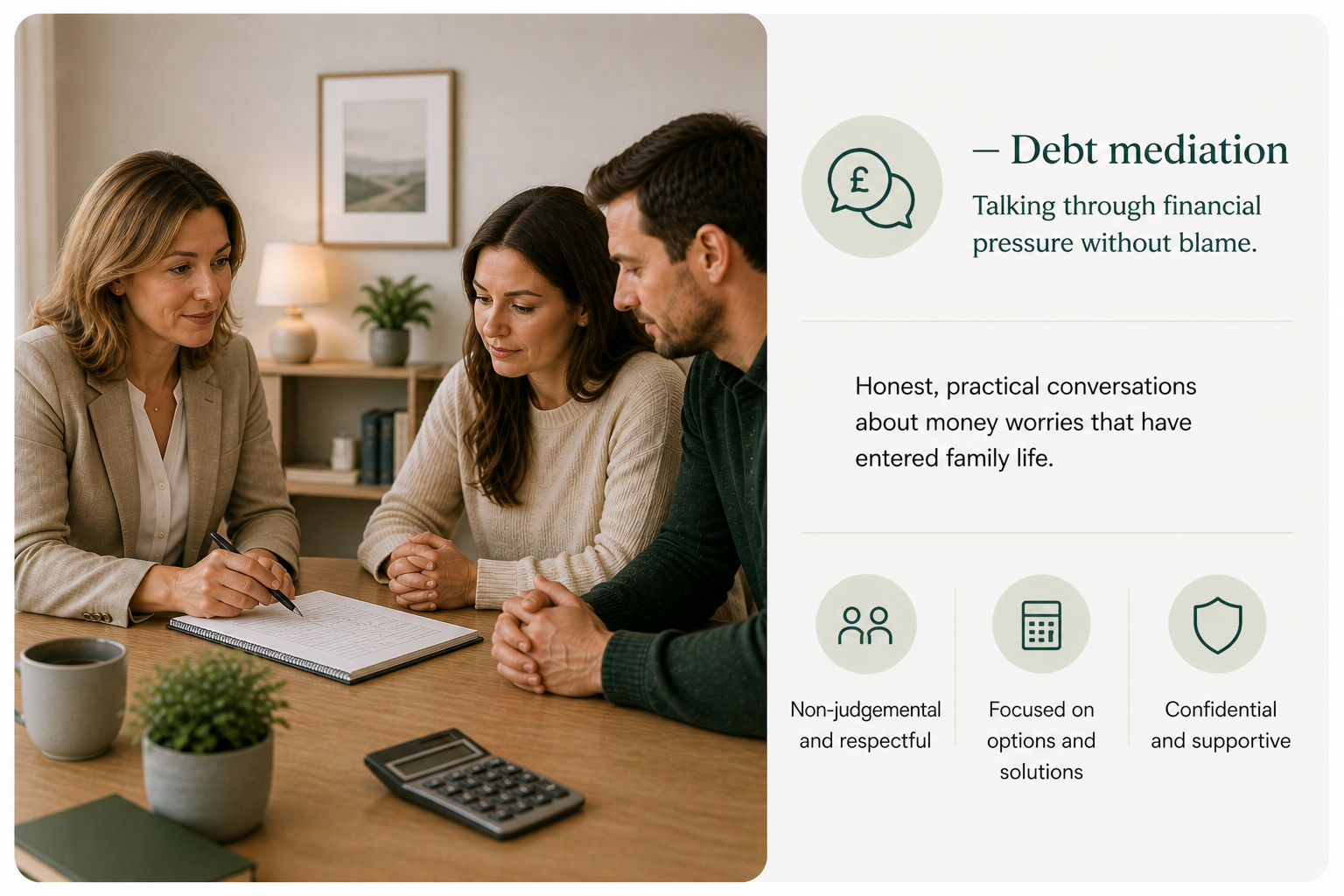
Debt can make a difficult family situation feel even heavier. Financial strain can leave people feeling overwhelmed and trapped, and that pressure becomes more complex during separation, especially when debt has worked its way into wider family finances. It might involve housing, daily expenses, household bills, or decisions made during a period of upheaval.
Debt mediation offers families a chance to discuss these matters openly, in a practical and non-judgmental way. The focus is on understanding the situation, easing pressure where possible, and considering realistic ways forward. That can include conversations about affordability, priorities, and the path back toward greater stability. With the right tone, money worries become more manageable. People are given space to think, rather than react.

Couples and families often need to sort through a number of financial matters following separation, and financial mediation provides a space for that work. It can cover income, savings, debts, the family home, household spending, pensions and other matters that need to be disclosed and agreed.
Money is rarely just money. It often carries emotional weight, future planning and concerns about fairness. Financial mediation gives those discussions a structured, even-handed setting. It helps people understand what is needed, what assets and responsibilities are involved, and what arrangements are likely to hold up over time. It does not promise to make every financial detail simple. It helps to make it clearer — and when people understand the position better, agreement often becomes easier to reach.
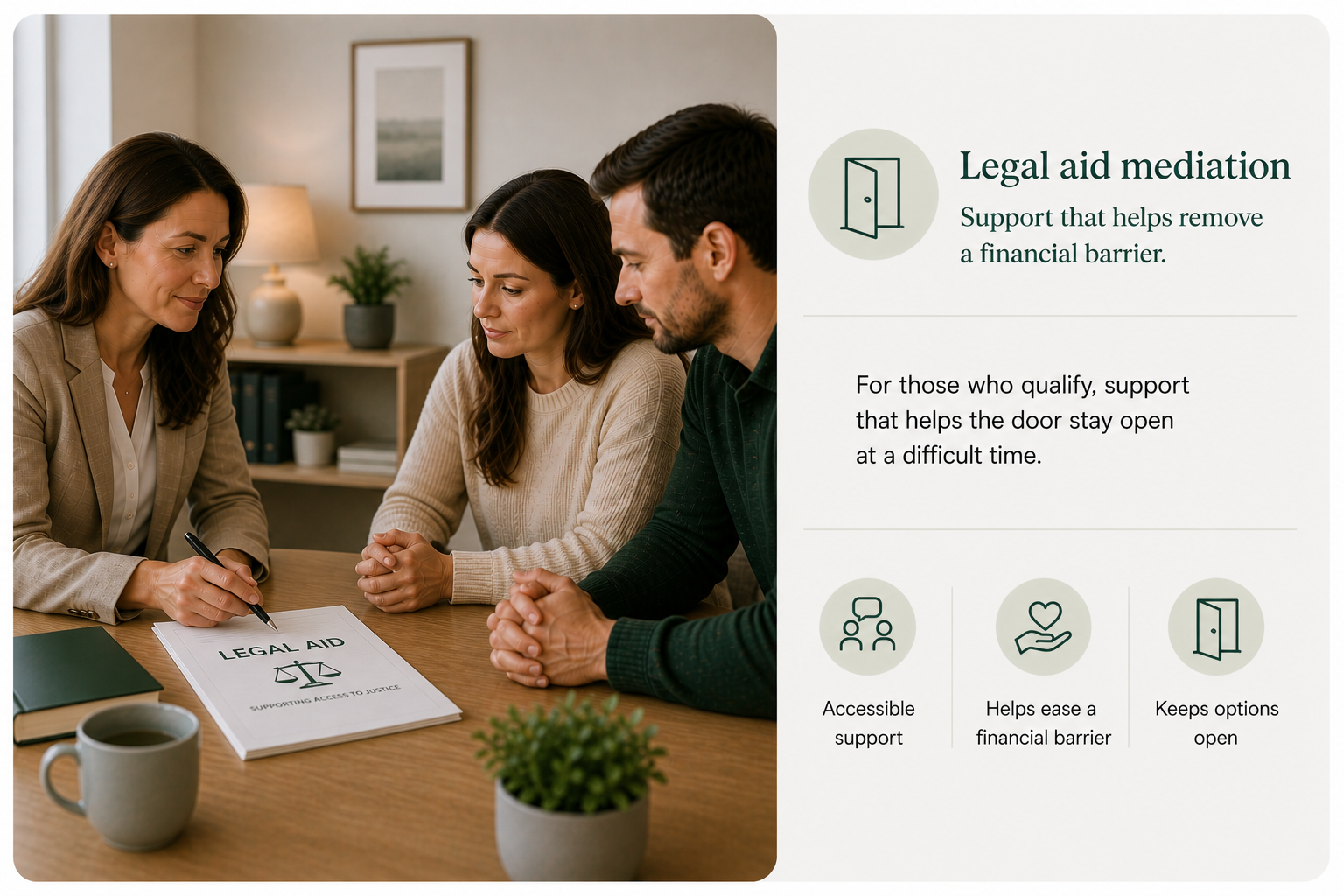
Family support carries a cost, and for some that cost can be a real barrier. Legal aid can ease that pressure for people who qualify, helping the process feel reachable when it is most needed. Mediation is rarely entered into lightly when finances are already stretched. Where someone is eligible, the availability of legal aid can mean the difference between being able to move toward a solution and feeling unsure where to begin.
This kind of support can be particularly meaningful where matters are time-sensitive, or where a more measured process is the most useful way to ease tension. The most helpful first step is usually to understand what may be available — many people find their options are wider than they had expected.

Pensions are often one of the most overlooked aspects of a financial separation, and yet they matter very much. Because pensions concern the future, they can be harder to compare fairly. People may not always know what they are worth, how they should be considered, or what a reasonable arrangement might look like. That can make pension discussions feel daunting — or easy to set aside.
Pension dispute mediation focuses these conversations into clearer, more manageable territory. It helps people work through the issue with appropriate support, so the practical and financial implications can be properly understood. Decisions made today can shape retirement security for years to come. Mediation gives people the chance to consider that future thoughtfully, rather than letting it remain vague.
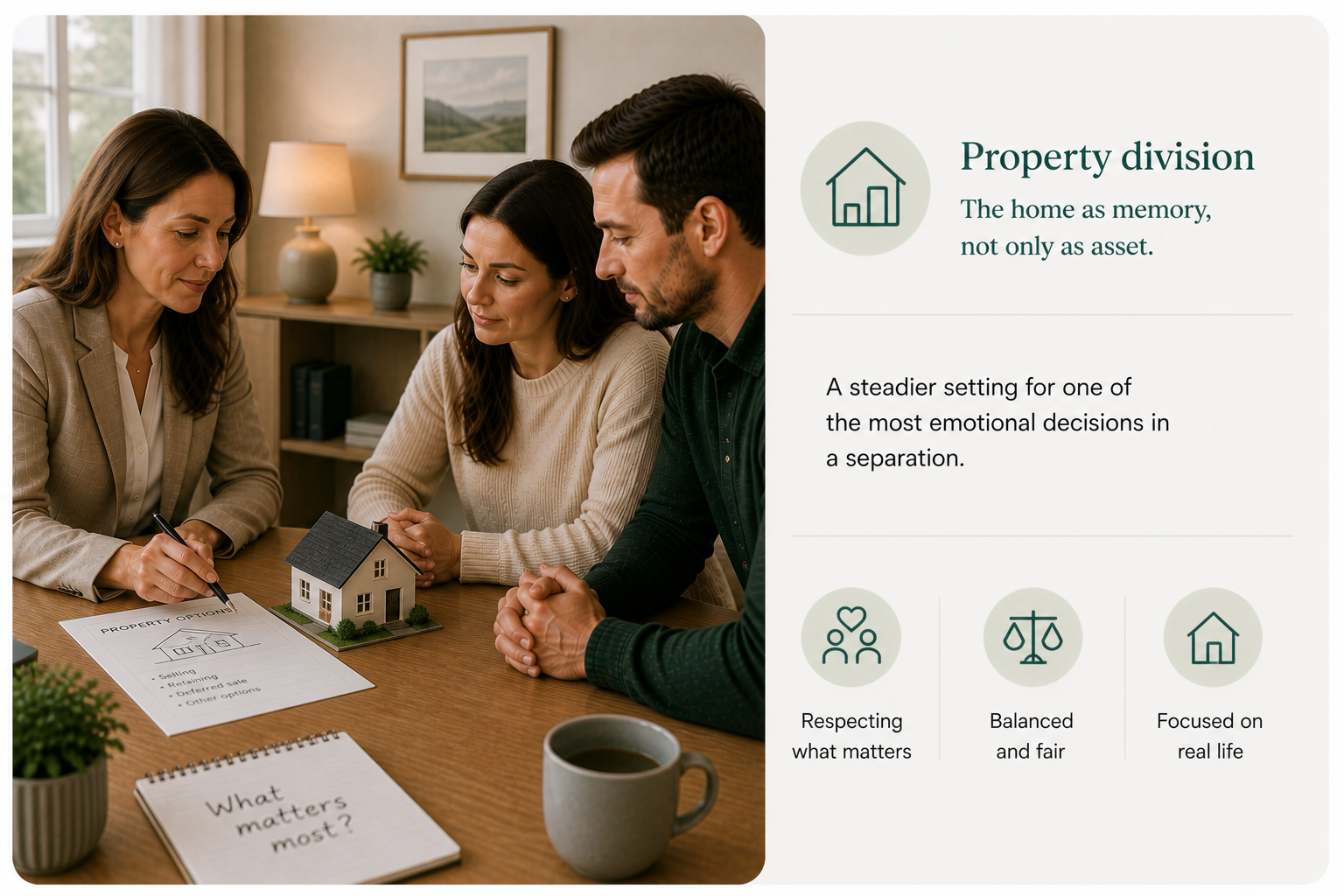
Property is often one of the largest and most emotionally complicated parts of a separation. A home is not only a financial asset. It carries memories, routines and a sense of familiarity. Deciding what happens to it can be one of the harder parts of moving on.
Property division mediation gives these conversations structure that helps reduce friction. It might involve the family home, jointly owned property, or other land that needs to be addressed. The discussions can become tangled because they are practical and emotional at the same time. Housing, children, affordability and fairness all sit together. Mediation helps make those concerns visible, and workable. When property is handled in a calmer setting, the wider separation often becomes easier to move through.
Court has its place, and there are times when it is necessary. For many family matters, however, it is not the best first move. The two approaches differ in tone, pace, cost — and in how much agency people retain in the outcome.
Sometimes essential, but often a heavy first response when other paths may help.
People remain in the conversation. The process is solution-led, not adversarial.
Two simple ideas hold the process together. Confidentiality creates safety. Neutrality creates balance. Together, they create the kind of environment in which progress is more likely.
Confidentiality means the conversation takes place safely and privately. It encourages people to speak more openly. It lets difficult subjects be discussed with less fear of judgement or external pressure. It also builds trust in the process itself — when people know the care being taken with what they share, they engage more meaningfully.
Neutrality is the role the mediator holds. They do not take sides. They are not there to defend one person against the other. They guide the discussion impartially, keeping both individuals focused on the matters that need to be resolved. That neutrality is what stops mediation from becoming another arena for blame.
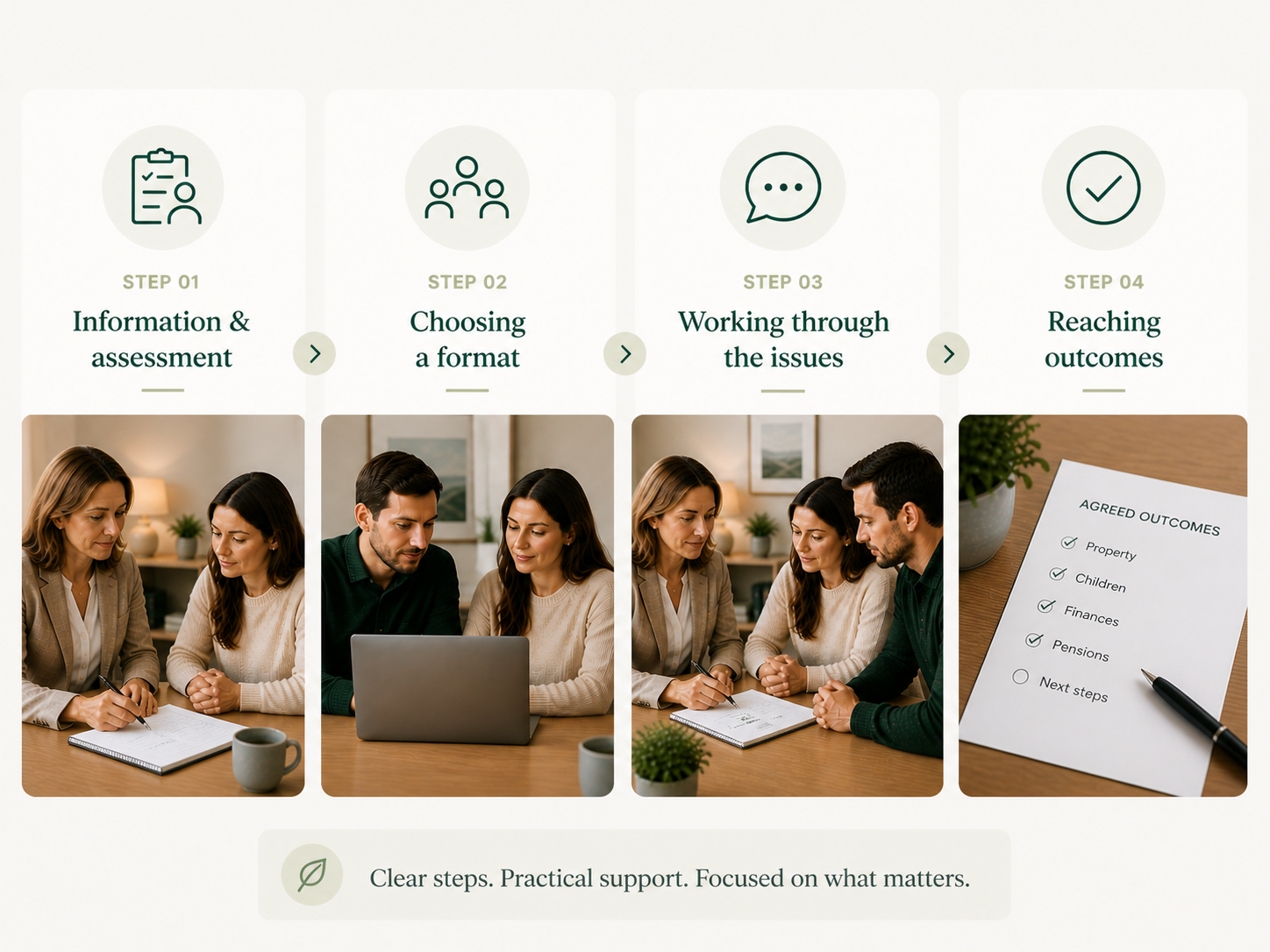
The process is designed to be transparent and easy to follow. It typically begins with a first conversation, often a MIAM, where the situation is discussed and the next steps considered. From there, where appropriate, the process moves into facilitated discussions.
An initial private conversation to consider whether mediation is right, and what stage to begin at.
Joint sessions, online mediation or shuttle mediation — chosen based on what suits both people best.
Matters are taken in turn — often beginning with the most pressing — across as many sessions as needed.
Outcomes can be full or partial. Even when not everything is resolved, mediation often clarifies the next step.
The mediator stays neutral throughout. Their role is to help people understand each other, communicate more clearly, and shape outcomes that feel achievable. Some families reach agreement quickly. Others take more time. The pace depends on the complexity of the situation and on what feels right for the people involved. Mediation is not about doing everything perfectly — it is about steady, meaningful progress.
Mediation has something to offer a wide range of family situations. The flexibility of the process is one of the reasons it tends to work well — families are complicated, and mediation aims to respond to that complexity in a structured and human way.
It can support couples who are separating and need to make decisions about children, money or property. It can support parents struggling with communication. It can help those going through a divorce who would prefer a quieter route. It can help grandparents worried about losing contact with a grandchild. It can support families dealing with debt or wider financial pressure. It can help anyone who simply wants a more constructive route than court.
It can also help those who are not yet sure whether mediation is right for them. The first conversation is sometimes valuable on its own — simply because it offers clarity. People begin to understand the choices in front of them, the way the process works, and what is most likely to help.
Mediation is not a rigid format reserved for one type of situation. It is for people who want to address difficult matters with less conflict and more compassion, About Us. That includes people who arrive feeling exhausted, those who are unsure where to begin, and those who simply want to move forward in a way that respects everyone involved.
Family conflict affects people in ways that are not always visible — confidence, sleep, focus, parenting, finances and general peace of mind can all carry the weight. That is exactly why this service exists, with dignity, clarity and practical support woven into its foundations. The aim is not to make hard things easy. It is to handle them properly, so that fewer people end up in worse situations as a result of a process that should have helped them.
Below are some of the questions that come up most often. Every situation is different, and a first conversation is the right place to consider what fits.
The aim is to help people work through family matters through conversation, rather than conflict. The process gives shape to difficult discussions and supports people in shaping their own decisions.
Often, yes. Where joint discussion would be too difficult, mediation can be adapted using shuttle mediation or online mediation. Suitability depends on the situation.
Children only take part directly when child-inclusive mediation is appropriate and well-prepared. More often, parents work through the issues with the support of the mediator.
No. Mediation can support separating couples, parents, grandparents and wider family members where there is disagreement or uncertainty about arrangements.
Yes. That can include financial mediation, debt mediation, property division and pension discussions, all in a more grounded environment.
This is exactly when mediation can help. Shuttle mediation or online mediation can create the distance and structure needed for the conversation to continue safely.
Yes. Mediation is a confidential process, which is a key reason open and honest conversation can take place.
No. Mediation is a process for negotiation and settlement. Depending on the circumstances, legal advice may still be useful and should be sought independently where needed.
Not every mediation ends with a complete agreement. Even partial agreements can be valuable — narrowing the issues, easing tension, and pointing the way to sensible next steps.
Family life can feel uncertain. Children, finances, property and communication can all rise at once, and it can be hard to know where to begin. Mediation offers a way to take the first step at a less fraught pace — calm, considered and grounded in dignity.
National Mediation brings together family mediation, divorce mediation, MIAMs, online mediation, shuttle mediation, child access support and a range of further pathways into a single service shaped around real families. The aim is simple — to help families resolve matters with greater clarity, more care, and less unnecessary conflict.
For many, that is what is needed. Not a fight. Not more confusion. Not another system that quietly adds to the weight. A consistent, human process that helps the conversation continue, and gently shapes a path toward something better.